Kinsman-redeemer
Hebrew גֹּאֵל go'el
In ancient Israel, if you fell into poverty, lost your land or sold yourself into slavery, the law named someone to rescue you: your nearest relative. The book of Ruth turns on that duty.
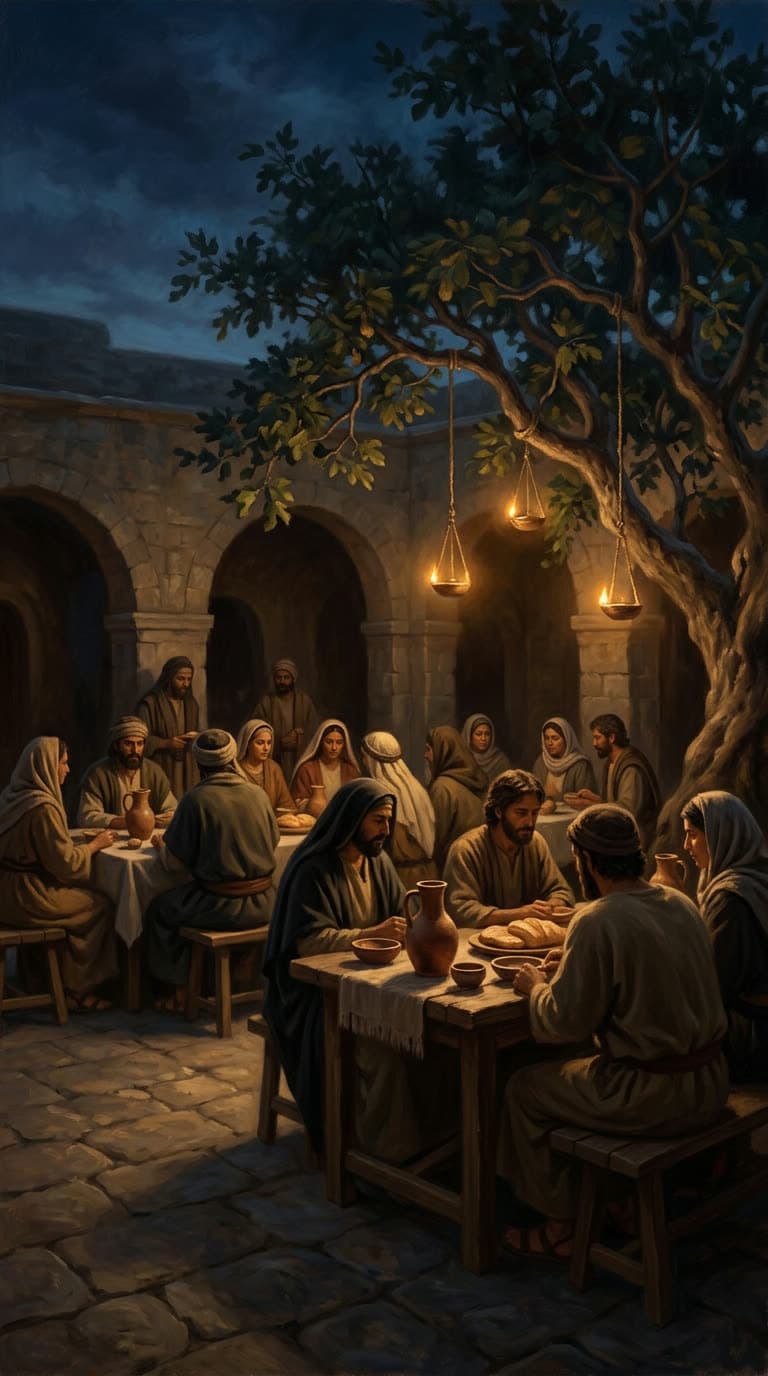
What a kinsman-redeemer was
The Hebrew word is go'el, “one who redeems”. In the law of Moses, the go'el was the closest male relative, and he had the right, and the duty, to step in when family members could not help themselves:
- Buying back land a relative had been forced to sell, so it stayed in the family (Leviticus 25:25).
- Buying back freedom for a relative who had sold himself into slavery (Leviticus 25:47–49).
- Carrying on the family name when a man died without a son, through a related duty to marry his widow (Deuteronomy 25:5–10).
If your brother becomes impoverished and sells some of his property, his nearest of kin may come and redeem what his brother has sold.
Leviticus 25:25 (BSB)
Boaz and Ruth
Naomi came home to Bethlehem a widow with nothing, bringing her Moabite daughter-in-law Ruth, also a widow. Ruth gleaned barley in the fields of a man named Boaz, and when Naomi heard his name, she saw hope:
Then Naomi said to her daughter-in-law, “May he be blessed by the LORD, who has not withdrawn His kindness from the living or the dead.” Naomi continued, “The man is a close relative. He is one of our kinsman-redeemers.”
Ruth 2:20 (BSB)
One night at the threshing floor, Ruth asked Boaz to take up that role. He was willing, but there was a closer relative with the first right (Ruth 3:12). The next morning, at the town gate, the other man refused, removed his sandal to seal it, and Boaz bought the land and married Ruth before the elders. The story ends with a baby:
13 So Boaz took Ruth, and she became his wife. And when he had relations with her, the LORD enabled her to conceive, and she gave birth to a son.
14 Then the women said to Naomi, “Blessed be the LORD, who has not left you this day without a kinsman-redeemer. May his name become famous in Israel.
15 He will renew your life and sustain you in your old age. For your daughter-in-law, who loves you and is better to you than seven sons, has given him birth.”
16 And Naomi took the child, placed him on her lap, and became a nurse to him.
17 The neighbor women said, “A son has been born to Naomi,” and they named him Obed. He became the father of Jesse, the father of David.
The kinsman-redeemer the women praise is the child, Obed, who will carry on the family and care for Naomi. He became the grandfather of King David, and Matthew lists Boaz and Ruth in the family line of Jesus (Matthew 1:5).
God, the Redeemer
The Bible uses the same word for God. When He brings Israel out of Egypt, He acts as their go'el: “I will redeem you with an outstretched arm” (Exodus 6:6). Isaiah calls Him Israel's Redeemer thirteen times.
Thus says the LORD, the King and Redeemer of Israel, the LORD of Hosts: “I am the first and I am the last, and there is no God but Me.
Isaiah 44:6 (BSB)
And Job, having lost everything, holds on to this:
But I know that my Redeemer lives, and in the end He will stand upon the earth.
Job 19:25 (BSB)
Christians have long seen Boaz as a picture of Christ: a near kinsman, able and willing to pay the price, who takes an outsider in and gives her a name and a future.
Questions
- What is a kinsman-redeemer in the Bible?
- A close relative, in Hebrew a go'el, whose duty under the law of Moses was to rescue family members in trouble: buying back land they had sold, buying them out of slavery, and protecting the family line (Leviticus 25, Deuteronomy 25).
- Who was the kinsman-redeemer in the book of Ruth?
- Boaz, a relative of Naomi's late husband Elimelech. A closer relative had the first right but refused, so Boaz bought the family land and married Ruth (Ruth 4:1 to 10).
- Why did the other relative refuse to redeem?
- He was willing to buy the land, but not when it meant marrying Ruth too, because the land would pass to her son and not his own heirs: 'I cannot redeem it myself, or I would jeopardize my own inheritance' (Ruth 4:6).
- Why did the man take off his sandal in Ruth 4?
- It was how a transfer of property was confirmed at the time: 'a man would remove his sandal and give it to the other party' (Ruth 4:7). By handing it over, he gave his right of redemption to Boaz.
- How is Jesus our kinsman-redeemer?
- The Bible calls God the Redeemer of His people, and the New Testament says Jesus redeemed us at the cost of His own life. Like Boaz, He became our near kinsman by sharing our humanity, and He was both able and willing to pay the price.
- Where can I hear the book of Ruth read aloud?
- In Lampstand, the daily audio Bible. All four chapters of Ruth are read aloud in Walk by day and Sleep by night, with the text on screen and a painting for each scene. Genesis is free to hear, every chapter.