Hosanna
hoh-ZAN-uh · Greek ὡσαννά hōsanna · Hebrew הוֹשִׁיעָה נָּא hoshi'a na
Hosanna sounds like pure praise, but it began as a plea for help: save us, please. On the day Jesus rode into Jerusalem, a crowd waving palm branches shouted it as both at once.
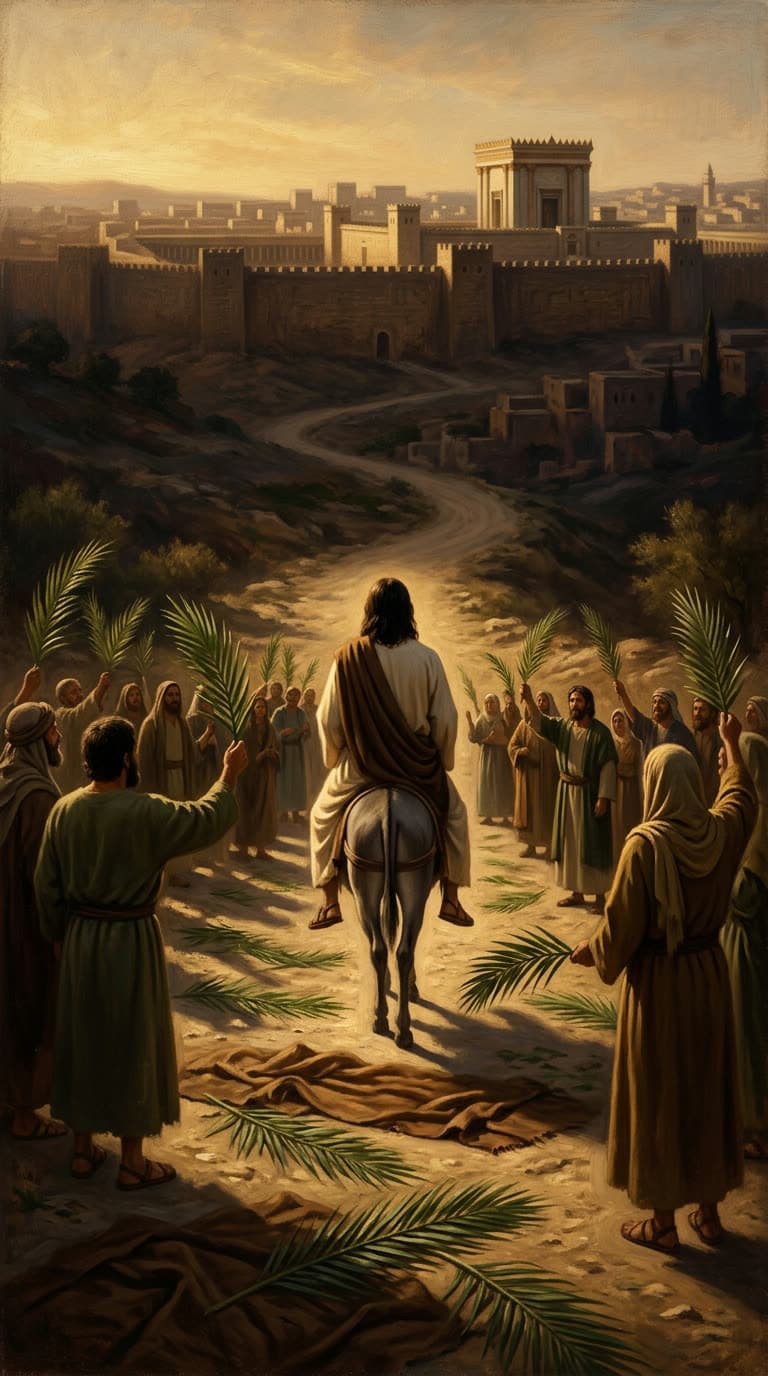
Hear it in John 12
Five days before the Passover, word spread through the city that Jesus was coming. The crowd went out to meet Him with palm branches, and John records what they shouted:
12 The next day the great crowd that had come to the feast heard that Jesus was coming to Jerusalem.
13 They took palm branches and went out to meet Him, shouting: “Hosanna!” “Blessed is He who comes in the name of the Lord!” “Blessed is the King of Israel!”
14 Finding a young donkey, Jesus sat on it, as it is written:
15 “Do not be afraid, O Daughter of Zion. See, your King is coming, seated on the colt of a donkey.”
What hosanna means
Hosanna is the Greek spelling of a Hebrew phrase, hoshi'a na: “save, please” or “save us, we pray”. The first part comes from the same Hebrew root as the names Joshua and Jesus, which mean “the LORD saves”.
By the time of Jesus the phrase was sung every year at the great feasts, and it had become a shout of welcome and joy as well as a prayer. When the crowd cried “Hosanna!”, they were praising Him and asking Him to do what His name said.
The psalm they were singing
The words come from Psalm 118, a song of thanksgiving sung by pilgrims going up to the temple. In the Hebrew, verse 25 is the hosanna itself, which the Berean Standard Bible translates; the very next line is the blessing the crowd shouted at Jesus.
24 This is the day that the LORD has made; we will rejoice and be glad in it.
25 O LORD, save us, we pray. We beseech You, O LORD, cause us to prosper!
26 Blessed is he who comes in the name of the LORD. From the house of the LORD we bless you.
The same psalm says, “The stone the builders rejected has become the cornerstone” (Psalm 118:22), a verse Jesus applied to Himself in the days that followed.
Where hosanna appears
The word itself appears six times, all in the Gospels and all about the same day: in Matthew 21:9 and 21:15, Mark 11:9–10 and John 12:13. In Matthew the children in the temple courts take it up afterwards, to the indignation of the chief priests:
But the chief priests and scribes were indignant when they saw the wonders He performed and the children shouting in the temple courts, “Hosanna to the Son of David!”
Matthew 21:15 (BSB)
Christians have sung it ever since, especially on Palm Sunday, the Sunday before Easter that remembers Jesus' entry into Jerusalem.
Questions
- What does hosanna mean?
- Save us, we pray. It is the Hebrew phrase hoshi'a na from Psalm 118:25, written in Greek letters. By Jesus' time it was also a shout of praise and welcome, so it carries both meanings: a prayer for salvation and joy at the one who brings it.
- How do you pronounce hosanna?
- In English it is usually said hoh-ZAN-uh, with the stress on the middle syllable. You can hear it read in John 12:13 in the clip on this page.
- Where is hosanna in the Bible?
- Six times in the Gospels, all on the day Jesus entered Jerusalem: Matthew 21:9 and 21:15, Mark 11:9 and 11:10, and John 12:13. The phrase behind it is Psalm 118:25.
- What does 'hosanna in the highest' mean?
- It calls for the praise to reach the highest heaven, or asks God in the highest heaven to save. The phrase is in Matthew 21:9 and Mark 11:10.
- Why did the crowd wave palm branches?
- Palm branches were a sign of victory and national celebration, carried at the Feast of Tabernacles and at joyful welcomes. Waving them for Jesus treated Him as a king arriving in triumph, which is why John adds that they cried, 'Blessed is the King of Israel!'
- Where can I hear John 12 read aloud?
- In Lampstand, the daily audio Bible. The whole Gospel of John is read aloud in Walk by day and Sleep by night, with the text on screen and a painting for each scene. Genesis is free to hear, every chapter.